The Cambridge Companion to Marx by Terrell Carver
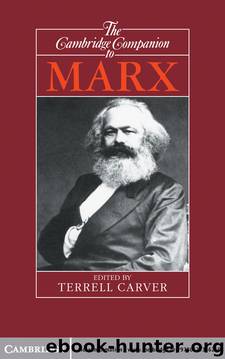
Author:Terrell Carver [Terrell Carver]
Language: eng
Format: epub
ISBN: 9780521366250
Publisher: Cambridge University Press
FORMAL DEMOCRACY AND THE PARASITE STATE
The repression of artisan, peasant, and worker revolt was a glaring anomaly for a liberal theory of a (potentially) neutral state. In contrast, the Babeuvists, Silesian weavers, radical Chartists, and many others plausibly explained the state’s surprising partisanship in the light of its service to the rich. As Marx’s Eleventh Thesis on Feuerbach emphasized, the collective practice of suffering and (democratic) rebellion was an impetus for accurate social theory. These political experiences and clashing opinions – embryos of opposing theories – enabled many to see the truth of capitalist relations. To capture the conflict between the new republican equality of suffrage and the reality of peasant exploitation, Marx’s The Class Struggles in France insisted that “revolutions are the locomotives of history.” Radical insights into class opposition, the ruling-class domination of the state, and the state’s misleading appearance in “normal” (less overtly conflictual) times refine this common explanation. Put differently, the ordinary political contrast between formally democratic or neutral appearance and exploitative essence led Marx to distinguish between a governing group and its sometimes complex relationship to a social ruling class.
Marx then offered two accounts of the (apparent) autonomy of the state to accompany this class explanation. His earlier, less compelling explanation drew on Aristotle’s first thesis: that humans are political animals. Marx’s conception of species being (Gattungswesen) contrasted a democracy in which the citizens share public activities with the “illusory” universality of the declarations of the Rights of Man that presaged capitalist parliamentarianism. His 1843 On the Jewish Question maintained that the latter regime would paradoxically join the real activities of competitive, isolated individuals in civil society with an alien universality, the liberal democratic state:
Far from viewing man here in his species-being, his species-life itself – society – rather appears to be an external framework for the individual, limiting his original independence.… The political liberators reduce citizenship, the political community, to a mere means for preserving these so-called rights of man and … the citizen thus is proclaimed to be the servant of the egoistic man, the sphere in which man acts as a member of the community is degraded below that in which he acts as a fractional being, and finally man as bourgeois rather man as citizen is considered to be the proper and authentic man. (Marx and Engels, 3/1975:164)
This new interpretation contrasted a weak, minimal regime, pitting state against society, with a vigorous ancient democratic community of citizens. Marx simultaneously emphasized alienation’s harms to the poor. Yet his first use of the metaphor “state against society” partly concealed, in a liberal vein, the class character of contemporary democracy even where he invoked that character to explain the sundering of society and state.
Marx’s second, more sophisticated interpretation of partial autonomy refines Aristotle’s thesis on extreme democracy and (counter) revolution. Located in his historical writings on The Class Struggles in France, The Eighteenth Brumaire of Louis Bonaparte, and The Civil War in France, this account articulates general themes of his political theory.
Marx thus captured
Download
This site does not store any files on its server. We only index and link to content provided by other sites. Please contact the content providers to delete copyright contents if any and email us, we'll remove relevant links or contents immediately.
| Anarchism | Communism & Socialism |
| Conservatism & Liberalism | Democracy |
| Fascism | Libertarianism |
| Nationalism | Radicalism |
| Utopian |
The Secret History by Donna Tartt(19128)
The Social Justice Warrior Handbook by Lisa De Pasquale(12199)
Thirteen Reasons Why by Jay Asher(8927)
This Is How You Lose Her by Junot Diaz(6900)
Weapons of Math Destruction by Cathy O'Neil(6290)
Zero to One by Peter Thiel(5816)
Beartown by Fredrik Backman(5772)
The Myth of the Strong Leader by Archie Brown(5517)
The Fire Next Time by James Baldwin(5458)
How Democracies Die by Steven Levitsky & Daniel Ziblatt(5227)
Promise Me, Dad by Joe Biden(5161)
Stone's Rules by Roger Stone(5093)
A Higher Loyalty: Truth, Lies, and Leadership by James Comey(4974)
100 Deadly Skills by Clint Emerson(4936)
Rise and Kill First by Ronen Bergman(4804)
Secrecy World by Jake Bernstein(4762)
The David Icke Guide to the Global Conspiracy (and how to end it) by David Icke(4730)
The Farm by Tom Rob Smith(4518)
The Doomsday Machine by Daniel Ellsberg(4497)
